
Framing the why of an experience — Mothership
Mothership is a Figma plugin that frames “the why of an experience” through dialogue. As generative AI does the making in an instant, what the mother ship carries is what comes before — judgment. It brings a hypothesis and a pick to build the why with you, cites UX principles as rationale, and keeps a rationale-backed design doc. The decisions you make land as real, editable Figma layers. Published on Figma Community in June 2026.
At the center is the “why” — judgment remains
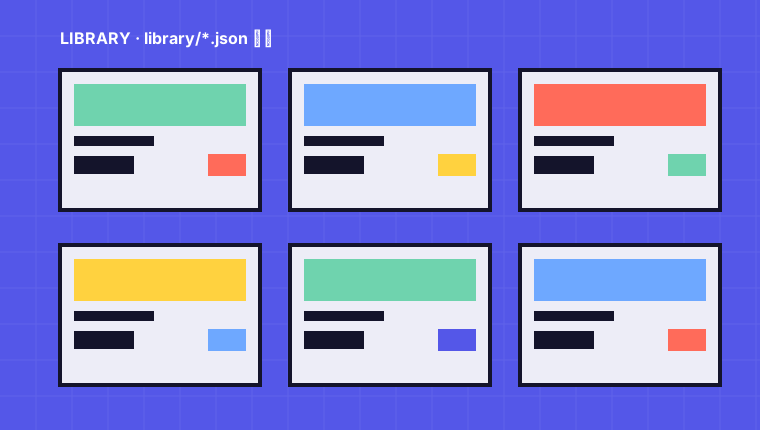
What Mothership puts at its center is not the AI, nor the output, but judgment. It builds “the why of an experience” with rationale and keeps the decision, its reasoning and the design in a single mothership.json and a .md design doc. Claude Code edits it "the same way it writes code," and the plugin builds it natively into Figma. What's saved is not an image or a generation log but the judgment and the design themselves. So whatever the AI is — Claude, or the next model — the judgment stays in your hands.
Mothership: why → judgment (with rationale) → Figma → a design doc that accrues (judgment stays in your hands)
Speak, and the design is born
"Make a three-plan pricing table." "Recreate this site's hero." Ask in words and Claude writes the source, and it builds into the connected Figma as editable layers. Frames, auto layout, rounded corners, Japanese fonts, shadows, SVG logos — the "real thing," not pasted images. It erases the fatigue of moving your hands from zero.

Not just generation — building from upstream (design & strategy)
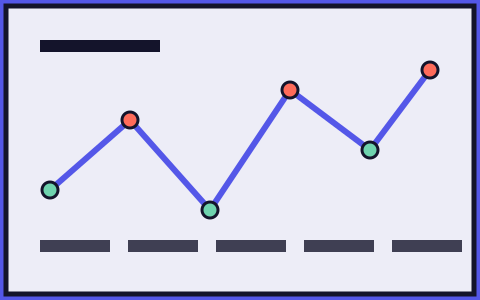
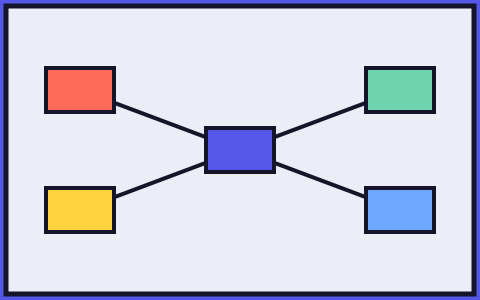
Claude Code's real strength is "thinking." So Mothership generates into Figma not only the UI but its upstream — personas, customer journeys, user flows — just by talking. Since the content is mostly "boxes and text," precision comes easily, and the AI thinks through the contents of the diagram too. No moving to Miro or FigJam — the artifacts of design thinking build straight onto the board.

Tidy, accrue and automate any frame
Generation is the entrance. The real value is beyond it. It reads frames that "already exist" on the board — external banners, hand-drawn, even ones the official AI made — and tidies them by naming, font unification, spacing and auto-layout, then lets you edit by conversation: "change the color," "make the heading bigger." Colors are auto-tokenized into Figma Variables and text into Text Styles — a team's own design system grows out of real, working design.

Symbiosis with the official AI
For fresh generation, Figma's official AI is strong. Where Mothership plays is before it, and beyond it — from framing “the why of an experience,” to tidying, accruing and automating the design already on the board. The official AI makes the UI; Mothership frames the "why," tidies and accrues. Not a competitor but a symbiotic layer. Because judgment stays with you as a source in hand, the brain (the AI) can be swapped at any time — no single AI holds your tool for judgment.
Precision of the finish is the value
What professionals judge is the precision of typography, spacing and proportion. If that's loose, drawing by hand is faster — so it won't get used. That's why Mothership places its value not on photos or flash but on "precision of finish." An edit mode that overlays a reference image and refines by the number takes on that final push. The judgments and patterns you've refined accumulate in the design docs, so the next time is faster. An endless loop that sharpens the more you use it — that is this product's value.
People decide. Knowledge accumulates.
What is inherited is the design philosophy.
Today Mothership may look like "a tool that generates Figma from chat." But what it aims at is an environment where an individual's or an organization's judgment and design knowledge accumulate, are reused and keep growing — and ultimately, beyond a Figma plugin, a standalone environment that builds up judgment. The AI is merely the translator for that.
* Generation, URL recreation and design/strategy generation work in the public version. The latest version with "tidy any frame / edit by chat / tokenize" is rolling out.